
Test Match Lunch Timing: Duration, Rules, Schedule & Everything You Need to Know
If you have ever watched a Test match and wondered why play suddenly stops mid-afternoon, you are not alone. Test cricket is the only format of the game where structured meal breaks are part of the official playing conditions. The test match lunch timing is one of the most discussed yet least understood aspects of cricket’s longest format.
Whether you are a hardcore cricket fan, a fantasy cricket player, or simply someone planning to watch a Test match live, knowing exactly when lunch is taken and for how long helps you follow the game without confusion. This guide covers every detail: the official duration, ICC rules, country-wise schedules, weather-related changes, and the tactical side of the lunch break you probably never considered.
What Is the Lunch Break in Test Cricket?
In Test Match Lunch Timing is a scheduled break taken between the morning session and the afternoon session. It is one of two meal breaks in a day’s play, the other being the tea interval.
Unlike Twenty20 or ODI cricket, where there is no formal lunch break, Test cricket follows a strict three-session structure every day. The lunch break separates Session 1 (morning) from Session 2 (afternoon) and gives players time to rest, eat, and plan their next phase of batting or bowling.
The concept of scheduled meal breaks in cricket dates back to the 19th century. In the early days of the sport, players ate whenever it was convenient. As the game professionalised, formal intervals were introduced to manage player fitness, match flow, and spectator experience.
How Long Is the Lunch Break in Test Cricket?
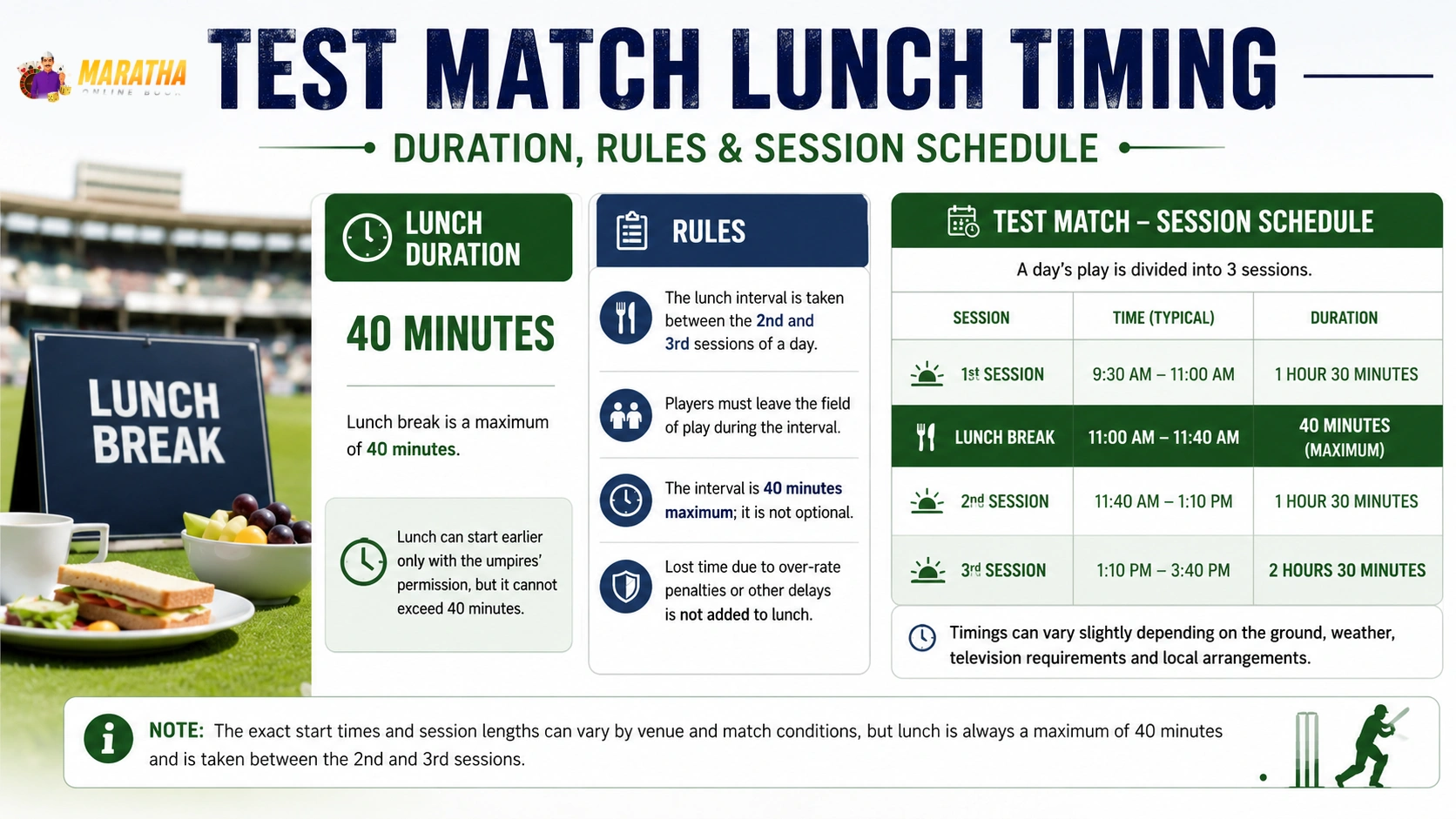
The lunch break in a Test match lasts exactly 40 minutes.
This duration is fixed under ICC Test Match Playing Conditions, Section 11.2.1.1, which states the lunch interval shall be 40 minutes from the call of “Time” until the call of “Play.” The MCC Law 12 also governs this, ensuring all ICC-sanctioned Test matches follow the same rule regardless of the host country.
Quick Answer: The lunch interval in Test cricket is 40 minutes the longest scheduled break in a single day’s play.
This makes lunch twice as long as the tea break, which lasts only 20 minutes.
Full Test Match Daily Session Schedule
A standard day of Test cricket is divided into three sessions separated by two breaks.
| Session | Activity | Typical Time (10:00 AM Start) |
|---|---|---|
| Session 1 | Morning play (approx. 30 overs) | 10:00 AM – 12:00 PM |
| Lunch Break | Rest interval | 12:00 PM – 12:40 PM |
| Session 2 | Afternoon play (approx. 30 overs) | 12:40 PM – 2:40 PM |
| Tea Break | Short interval | 2:40 PM – 3:00 PM |
| Session 3 | Evening play (approx. 30 overs) | 3:00 PM – 5:00/5:30 PM |
Times are approximate and vary based on the host country’s start time.
When Is Lunch Taken During a Test Match?
The official rule is clear: lunch is taken after 2 hours of play or after 30 overs whichever comes first.
The umpires make the final call on exactly when lunch is called. A few important points to understand:
- If 30 overs are completed before 2 hours, the umpires can call lunch at that point.
- If 2 hours pass before 30 overs are bowled, the session still ends for lunch.
- If a wicket falls just before lunch, the interval is still observed — play does not continue.
- If a team is 9 wickets down, the umpires may delay lunch slightly to complete the over or allow a fresh over to begin.
Test Match Lunch Timing by Country
Each Test-playing nation has its own traditional start time, which directly affects when lunch is taken. Below is a general guide to expected lunch timings around the world.
| Country | Match Start Time | Approximate Lunch Time |
|---|---|---|
| India | 9:30 AM IST | 11:30 AM – 12:10 PM IST |
| England | 11:00 AM BST | 1:00 PM – 1:40 PM BST |
| Australia | 10:00 AM local | 12:00 PM – 12:40 PM local |
| South Africa | 10:00 AM SAST | 12:00 PM – 12:40 PM SAST |
| Pakistan | 10:00 AM PKT | 12:00 PM – 12:40 PM PKT |
| West Indies | 10:00 AM local | 12:00 PM – 12:40 PM local |
| New Zealand | 11:00 AM NZST | 1:00 PM – 1:40 PM NZST |
| Sri Lanka | 10:00 AM SLST | 12:00 PM – 12:40 PM SLST |
These are standard times and can change based on ICC scheduling, weather, or specific tournament rules.
Lunch vs. Tea: Key Differences at a Glance
Both lunch and tea are scheduled intervals in Test cricket, but they differ in several ways.
| Feature | Lunch Interval | Tea Interval |
|---|---|---|
| Duration | 40 minutes | 20 minutes |
| Position in day | After Session 1 | After Session 2 |
| ICC Rule Reference | Section 11.2.1.1 | Section 11.2.1.2 |
| Strategic importance | High — major tactical reset | Moderate |
| Can be shortened? | Only by Match Referee | Only by Match Referee |
How Weather and Rain Affect Lunch Timing

Weather is one of the most common reasons test match lunch timing shifts from its scheduled slot. When rain interrupts play, the umpires and match referee have two main approaches:
1. Clock-Based Method
Lunch is taken at the scheduled clock time regardless of how many overs have been bowled. Even if only 10 overs have been played due to a rain delay, lunch is still called at the scheduled time.
2. Session-Based Method
Lunch is delayed until the required number of overs (approximately 30) are completed. This approach ensures teams get a full session of cricket before the break.
The choice between these two methods depends on weather forecasts, light conditions, and the match situation. The match referee has the authority to shorten the lunch interval in heavily rain-affected matches to recover lost playing time but this is rare and requires a proper reason.
Can the Lunch Break Be Delayed or Skipped?
In normal conditions, no the lunch break cannot simply be skipped. However, there are specific situations where it can be delayed:
- A wicket falls near lunch: The umpires may complete the ongoing over before calling the interval.
- Bad weather is approaching: If rain looks imminent, umpires may push through a few extra overs to bank playing time.
- An innings closes near lunch: If the last wicket falls within 30 minutes of the scheduled lunch, the interval can be taken immediately, combined with the 10-minute innings change-over break.
The Tactical Importance of the Lunch Break
The lunch interval is not just a meal stop it plays a real role in shaping how a Test match unfolds.
For Batters
Batters who survive to lunch after a tough morning session gain a crucial mental reset. The 40-minute break allows them to decompress, review their footwork, and return with a clearer head. Many batters have spoken about using the lunch break to adjust their game plan after a difficult first session.
For Bowlers and Fielding Teams
Bowling attacks use the lunch break to reassess their strategy. The captain and coach review which deliveries have been effective, what field placements to change, and whether to introduce a new bowler in the first over after lunch.
The “Post-Lunch Wicket” Phenomenon
Cricket fans and analysts have long noticed that batters are unusually vulnerable in the first few overs after returning from lunch. The disruption to rhythm, a change in focus, or simply a full stomach can contribute to an unexpected dismissal. The first over after lunch is often one of the most dangerous for batters.
Day-Night Test Match Lunch Timing
Day-night Test matches, played under floodlights with a pink ball, follow a different structure. Instead of traditional morning, afternoon, and evening sessions, they use a afternoon/evening/night session format.
In day-night Tests, the “lunch” break is sometimes replaced by a dinner interval, while the traditional tea break may shift to an earlier meal interval. The ICC Playing Conditions for day-night Tests specifically address these timing changes to account for the evening start and late finish.
Frequently Asked Questions (FAQs)
How long is the lunch break in Test cricket?
The lunch break in Test cricket is exactly 40 minutes, as defined under ICC Playing Conditions Section 11.2.1.1.
When is lunch taken in a Test match?
Lunch is taken after approximately 2 hours of play or 30 overs, whichever comes first during the morning session.
What time is lunch in a Test match in India?
In India, where matches typically start at 9:30 AM IST, lunch is usually taken around 11:30 AM to 12:10 PM IST.
What time is lunch in an England Test match?
In England, matches start at 11:00 AM BST, so lunch is typically taken around 1:00 PM to 1:40 PM BST.
Can the lunch break be shortened in Test cricket?
Yes, but only the match referee can authorise a shorter interval, and only in genuinely rain-affected matches where playing time needs to be recovered.
Is the lunch break the same in all Test-playing countries?
The duration (40 minutes) is fixed worldwide. The timing varies depending on the local start time of the match.
What is the difference between lunch and tea in Test cricket?
Lunch is 40 minutes and taken after Session 1. Tea is 20 minutes and taken after Session 2. Both are governed by ICC Playing Conditions.
What happens if the last wicket falls just before lunch?
If the last wicket falls within 30 minutes of the scheduled lunch time, the lunch interval is taken immediately, combining it with the standard 10-minute innings interval.
Do day-night Tests have a lunch break?
Not in the traditional sense. Day-night Tests restructure the sessions, and the “lunch” equivalent is often replaced by a dinner break due to the evening start time.
How many overs are bowled in a Test match session?
Approximately 30 overs per session, totalling around 90 overs across a full day’s play. However, over rates can affect the exact count.
Conclusion
Understanding test match lunch timing adds a whole new layer to watching and enjoying cricket’s ultimate format. The 40-minute lunch break, governed by ICC Playing Conditions and MCC Laws, is far more than a simple meal stop it is a tactical reset, a momentum shift, and a defining moment in any day of Test cricket.
Whether it is a batter surviving a hostile bowling spell to reach the lunch break, a captain resetting their bowling strategy over a plate of food, or a match referee adjusting schedules after a rain delay, the lunch interval shapes the game in ways many casual fans overlook.
The next time you watch a Test match and play pauses for lunch, you will know exactly why and what each team is doing in those 40 crucial minutes.
For the latest cricket schedules, live match updates, and expert analysis, visit MarathaBook — your go-to destination for everything cricket.

